During my undergraduate studies Milton Friedman and the Chicago School of Economics was vilified as though it was the root of all evil. The neo-right on the political realm took up many of his theories however through study, experience and my own research I’ve come to realize I think Mr. Friedman was misunderstood in many ways. I was particularity impressed with the emphasis and responsibility he placed on the individual in society and the citizens relationship and role with government. As a thought leader Milton Friedman’s legacy runs deep and looking forward it would not surprise me to see his perspectives pick up popularity within the emerging Global Social Enterprise sector, putting the responsibility on individuals and free enterprises to solve problems and not governments. He challenged John Maynard Keynes the king of western civilization economics for well over a generation, I respect that.
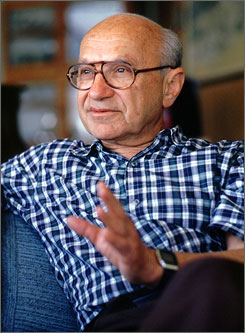
Milton Friedman (July 31, 1912 – November 16, 2006) was an American economist, statistician, and writer who taught at the University of Chicago for more than three decades. He was a recipient of the 1976 Nobel Prize in Economic Sciences, and is known for his research on consumption analysis, monetary history and theory, and the complexity of stabilization policy.[1] As a leader of the Chicago school of economics, he profoundly influenced the research agenda of the economics profession. A survey of economists ranked Friedman as the second most popular economist of the twentieth century after John Maynard Keynes,[2] andThe Economist described him as “the most influential economist of the second half of the 20th century … possibly of all of it.”[3]
Friedman’s challenges to what he later called “naive Keynesian” (as opposed to New Keynesian) theory[4] began with his 1950s reinterpretation of the consumption function, and he became the main advocate opposing Keynesian government policies.[5] In the late 1960s, he described his own approach (along with all of mainstream economics) as using “Keynesian language and apparatus” yet rejecting its “initial” conclusions.[6]
During the 1960s, he promoted an alternative macroeconomic policy known as “monetarism“. He theorized there existed a “natural” rate of unemployment and argued that governments could only increase employment above this rate, e.g., by increasing aggregate demand, only for as long as inflation was accelerating.[7]He argued that the Phillips curve was, in the long run, vertical at the “natural rate” and predicted what would come to be known as stagflation.[8] Though opposed to the existence of the Federal Reserve System, Friedman argued that, given that it does exist, a steady, small expansion of the money supply was the only wise policy.[9]
Friedman was an economic adviser to Republican U.S. President Ronald Reagan. His political philosophy extolled the virtues of a free market economic system with minimal intervention. He once stated that his role in eliminating U.S. conscription was his proudest accomplishment, and his support for school choice led him to found the Friedman Foundation for Educational Choice. In his 1962 book Capitalism and Freedom, Friedman advocated policies such as a volunteer military, freely floating exchange rates, abolition of medical licenses, a negative income tax, and school vouchers.[10] His ideas concerning monetary policy, taxation, privatization and deregulation influenced government policies, especially during the 1980s. His monetary theory influenced the Federal Reserve’s response to theglobal financial crisis of 2007–08.[11] In the field of statistics, Friedman developed the sequential sampling method of analysis
[youtube_sc url=”https://www.youtube.com/watch?v=m_q_Y0U1QcI&index=9&list=PLOv-GldVeFiXd1exZU0QLYC6ynwkQwbvz”]