Steam Assisted Gravity Drainage (SAGD) 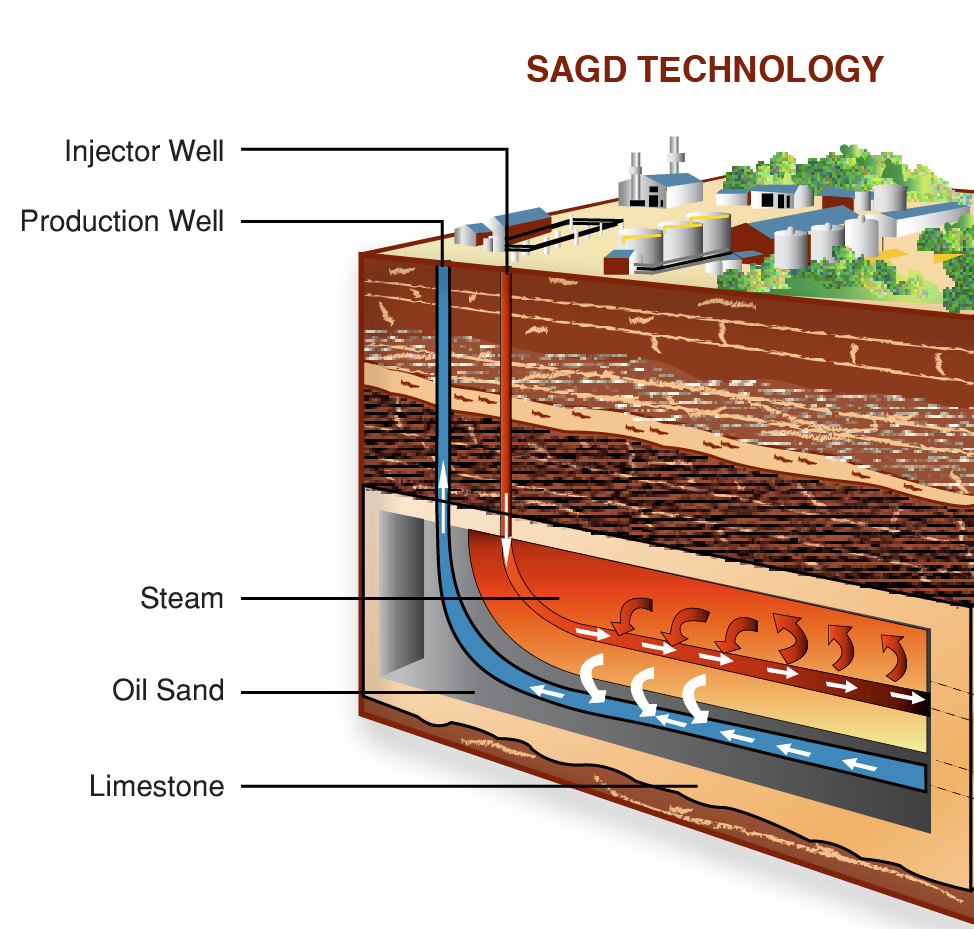
Steam Assisted Gravity Drainage (SAGD; “Sag-D”) is an Enhanced oil recovery technology for producing heavy crude oil and bitumen. It is an advanced form of steam stimulation in which a pair of horizontal wellsare drilled into the oil reservoir, one a few metres above the other. High pressure steam is continuously injected into the upper wellbore to heat the oil and reduce its viscosity, causing the heated oil to drain into the lower wellbore, where it is pumped out. Dr. Roger Butler, engineer at Imperial Oil from 1955 to 1982, invented the steam assisted gravity drainage (SAGD) in the 1970s. Butler “developed the concept of using horizontal pairs of wells and injected steam to develop certain deposits of bitumen considered too deep for mining.”[1][2] In 1983 Butler became director of technical programs for the Alberta Oil Sands Technology and Research Authority (AOSTRA),[1][3] a crown corporation created by Premier Lougheed to promote new technologies for oil sands and heavy crude oil production. AOSTRA quickly supported SAGD as a promising innovation in oil sands extraction technology.[2] – Via Wikipedia
Respecting The Process
For the last year I’ve been working for an international Oil & Gas Construction company in Fort McMurray, completing my pipe-fitting apprenticeship I started in Grande Prairie, AB working in the Patch a year earlier. In that time I’ve had the incredible opportunity of learning first hand many of the techniques, processes and inputs that are put into developing the facilities that extract and recover the oil that is deep below the ground.
The United States President, Barack Obama has openly criticized the Canadian Oil Sands, his main concern suggested in the media is the environmental impact and “dirty process” of recovery, however this logic is difficult to support. Recently Canada won a vote in its favor within the European Parliament that sought to have resources extracted out of the Canadian Oil Sands officially labeled “dirty”, it was a very important moral and economic win because the objective was to charge a deeper tax on exported crude from Canada to Europe. This tax could have hurt Canada’s competitive pricing which already suffers due to a lack of infrastructure and refining capacity. Below is a video that goes into more detail outlining the process with graphic support.