The Conflict Hits Home & In The Office
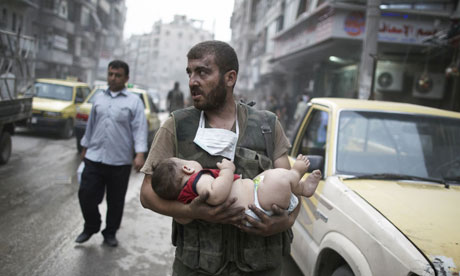
A Free Syrian Army fighter carries a baby, the only survivor in his family after an artillery round destroyed his home in Aleppo this month. Photograph: Sipa USA/Rex Features
You hear politicians in Ottawa everyday talking about foreign policy, values, etc. However I had the opportunity last week to interview for myself a young man who just arrived back to Canada a month ago after living in Damacaus, Syria for the last 15 years.
The job candidate was a first generation Canadian who was born to Syrian parents who immigrated to Canada in the 1980’s. After reviewing his profile I noticed that he was indeed the same age as me 27. He presented very well like a solid young professional. He had excellent work experience and a strong educational background. Before the conflict he was working in the Aerospace industry as a flight controller, with a bright future ahead. He had a home, car, career, a family with a very bright future. However he had to leave it all behind because in the end his personal health and safety was more important then any material wealth or societal status could ever be. I came away after speaking with the candidate really wanting to know more about the situation on the ground in Syria.
Last week I watched the 60 Minutes special on the internal Syria conflict. I also followed the American presidential debate between Obama and Romney that was on foreign policy. This was done in a hope that some substantive things would be talked about however these mediums left me unsatisfied. Fortunately I was follow @UN on twitter and was able to come across some very important information that addressed my concerns from the direct sources involved in the relief coordination.
Below you will find the key messages from the Relief Coordinator overseeing the UN Office for the Coordination of Humanitarian Affairs efforts in Syria This was originally posted October 25th, 2012 in regards to the key issues affecting Syria from a humanitarian standpoint.
Key Messages
- As the crisis deepens in Syria, I am extremely concerned for the up to 3 million people who are affected by the conflict and need help. Syrians continue fleeing their homes to safer areas and at least 1.2 million people have taken shelter in public buildings, parks and with host families. Humanitarian needs are growing and will keep growing as fighting continues. Targeting of medical facilities and staff has left thousands without access to health care and education, and, as the winter approaches, families will struggle to survive without essential clothing, adequate shelter and heating.
- All parties engaged in this conflict must do more to protect civilians and respect international humanitarian law. It is ordinary women, men and children that are caught up in the brutal violence and who suffer from the indiscriminate use of explosive weapons like cluster munitions. There are particularly horrific reports of the testimonies from children. I call on all parties to stop targeting civilians and to ensure that humanitarian organizations can provide assistance quickly, neutrally and
 impartially.
 - In Syria, the United Nations and humanitarian partners have managed to scale up and reach areas where people need help, despite the immense security challenges. In September WFP dispatched food for 1.5 million people and WHO delivered health assistance to 60,000 people including emergency care for the wounded, diarrhoea treatment and safe blood kits. UNHCR has helped nearly 190,000 people get essential household items, while UNICEF has helped 50,000 children with educational and psychosocial support. We are expanding our field presence and network of partners to reach even more people.
- More than 350,000 people have left Syria since the beginning of the conflict, and thousands are fleeing across borders every day. UNHCR estimates that this number is likely to rise to 710,000 by the end of the year. Many people are reluctant to register as they worry about the safety of family members still inside Syria. At least three-quarters of the refugees are vulnerable women and children. I thank neighbouring countries for continuing to keep their borders open, and remind the international community that we must help the refugees from other countries – Palestinian, Iraqi, Somali and others – who are also caught up in the crisis.
- The fighting must stop before more lives are needlessly lost. While the humanitarian operation is helping large numbers of people in many areas, it is hindered by lack of funding as well as insecurity and violence. We need more resources to be able to help more people.
- Humanitarian work is done on the basis of impartiality and neutrality. The only aim is to save lives and protect the vulnerable. These principles must be respected and it is vital that humanitarian aid remains free of any political agenda.
For further information, please call:
OCHA New York: Amanda Pitt, tel. +1 917 367 5126, mobile +1 917 442 1810, pitta@un.org
OCHA Geneva: Jens Laerke, tel. +4122 917 1142. Mobile +4179 472 9750, laerke@un.org
OCHA press releases are available at http://www.unocha.org and www.facebook.com/UNOCHA
To learn more about OCHA’s activities, please visit http://unocha.org/.